The business problem
“Two days” and “two business days” are not the same over a weekend. A short term label can also hide whether a deadline follows the order date, invoice date or a weekly bucket.
Make invoice deadlines follow agreed weekday rules, with a visible preview staff can check.
See the real screens ↓Explore 1 real view of this workflow. Select a task, show every screen, or enlarge an image to read the original controls.
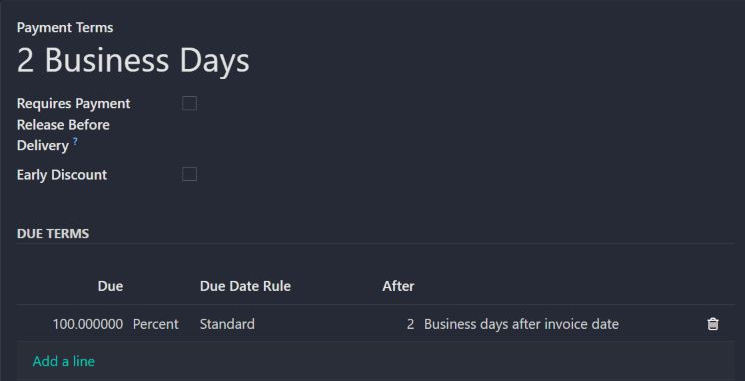
Actual Pro-A-Motors interface captures. Private identities and contact details are covered or outside the crop; screen data has not been replaced.
“Two days” and “two business days” are not the same over a weekend. A short term label can also hide whether a deadline follows the order date, invoice date or a weekly bucket.
Weekday-based terms skip Saturday and Sunday, and the weekly Monday term has its own explicit calculation.
Accounting can use deterministic due-date rules and explain the calendar behind the customer’s terms.
The saved term requires 100% of the amount two business days after the invoice date.
The actual due-term row says Business days after invoice date. The reviewed implementation skips Saturday and Sunday.
Use this term where a weekday-based deadline matches the agreement. Public holidays are not excluded by this implementation.
The invoice due date follows the configured rule, while statement cadence remains separate.
Use Odoo’s payment-term reference date for the calculation.
Advance the configured number of days while skipping Saturday and Sunday.
For the custom Monday term, find the invoice week’s Monday and add fourteen days.
Let statement frequency and the invoice due-date rule retain their distinct meanings.
Added the custom weekly-bucketed Monday term and related statement refinements.
Added weekday-based payment-term calculation and the two-business-day configuration.
Dates identify recorded implementation changes, not claimed rollout dates or measured results. Reviewed revisions: 13a6c6a, 3435405.
The implementation skips weekends; it does not consult a public-holiday calendar.
A later invoice date can place the item in a different weekly bucket from the sales-order date.
Invoices in the same Monday–Sunday week share the Monday two weeks after that week began.
Existing records are shown as captured. Private identities are covered or outside the crop. No business records were changed for this collection. Implementation history supports behavior beyond the visible screen; a still image is not an end-to-end test or a measured productivity result.
Built on Captivea CAP modules and Odoo. This case describes the subsequent Pro-A-Motors extensions and refinements recorded in the reviewed repository; it does not attribute the original CAP implementation to Toro.
Makes invoice due dates follow explicit weekday and weekly-bucket rules.